
Minimalist Design Principles for Luxury Living
For the high-net-worth individual, the home is no longer merely a place of display; it is now also a fortress of solitude, a mechanism for ‘cognitive rest.’ When the external world demands high-performance decision-making, the internal world must offer respite. This is where the principles of minimalist design transcend aesthetics and become essential to wellbeing.
However, true luxury minimalism is not deprivation. It is not the cold, ascetic white box of earlier times. Rather, it is an exercise in intentionality. It is the sophisticated art of subtraction, removing the superfluous to allow architecture, craftsmanship, and life itself to breathe. At The Revealry, we define this approach not as living with nothing, but as living with what matters. In this piece, we explore how bespoke design principles can construct a life of clarity, precision, and clutter-free calm.
FROM MINIMALISM TO ESSENTIALISM
To master clutter-free living, one must first distinguish between scarcity and selectivity. We prefer the term Essentialism. Traditional minimalism often risks feeling sterile—a gallery space that prohibits the messiness of actual life. Essentialism (or warm minimalism) draws from the Japanese concept of Ma (negative space) and the tactile warmth of Scandinavian design. It posits that a room should contain only that which is beautiful or functional, but that those objects should be rich in texture and provenance.
In a luxury context, this means curating the environment so that every object has breathing room. It is the decision to commission one incredible, hand-finished walnut dining table rather than filling a room with three mediocre pieces of furniture. By reducing the quantity of objects, we exponentially increase the quality of the experience.
THE ARCHITECTURE OF STORAGE
The primary enemy of minimalism is not possession, but displacement. Clutter is simply a failure of infrastructure. Off-the-shelf storage solutions rarely suffice for the complex lives of luxury homeowners because they deal in generalities. A standard drawer is a void waiting to become a junk drawer. True minimalist living requires hyper-organised joinery. This approach demands a rigorous audit of one's lifestyle. It involves, for instance, designing a specific, velvet-lined dock for a specific watch; a routed timber tray for a specific fountain pen; and integrated cabling for specific devices.
Critically, we advocate for the creation of a ‘landing zone,’ which is a bespoke console or joinery unit located at the primary entrance. This piece acts as a filter, catching the debris of the outside world (keys, post, devices) before it can migrate into the sanctuary of the main living areas. When every item has a designated architectural home, the surface clutter that generates visual noise vanishes.
VISUAL SILENCE
Modern life comes with mechanics—routers, gaming consoles, coffee machines, and workspaces. While functional, these elements can constitute clutter. The goal of minimalist bespoke design is to maintain the utility while erasing the visual footprint.
This is achieved through ‘invisible storage’. In open-plan luxury residences, the ability to transform a space from a working kitchen or office into a serene entertaining space is paramount. This is achieved through advanced joinery mechanisms, such as pocket doors. Unlike a standard hinge, a pocket door slides forward, pivots, and then retracts entirely into the carcass of the cabinet. This allows a cocktail bar or a home office to be fully accessible when in use, and then completely ‘erased’ behind a wall of matched grain timber when the evening begins. It allows the architecture to remain silent, even when the functionality is loud.
THE DETAIL IS THE DECORATION
When you remove the clutter and ornamentation from a room, there is nowhere left to hide. Minimalism is, paradoxically, the most unforgiving style to execute. In a maximalist room, a gap in the skirting board is hidden by a sofa; in a minimalist room, it is a glaring error. Therefore, the quality of the craftsmanship becomes the decoration. This is best exemplified by the ‘shadow gap’ aesthetic.
High-end ateliers often eschew handles and hardware, which can interrupt the visual flow of a wall of joinery. Instead, they utilise negative space—precision-routed channels that serve as finger pulls. This creates a ‘shadow line’ that defines the geometry of the piece. Because there is no hardware to distract the eye, the alignment of the doors, the consistency of the gap, and the grain of the wood must be absolute perfection. In this way, the void becomes as important as the solid.
MATERIALITY: WARMTH IN THE VOID
A common misconception is that a clutter-free home must feel cold. The antidote to sterility is material richness. When the eye is not distracted by ‘stuff,’ it focuses intensely on surface. This drives high-end artisans to champion the ‘honesty of materials.’ We rely on the natural character of the materials to provide the interest that knick-knacks usually would. They might pair a lime-washed wall with a bespoke cabinet crafted from Pippy Oak, where the chaotic, beautiful grain of the timber becomes the artwork; or they might contrast the cool, smooth surface of a marble island with the rough, tactile warmth of a bouclé sofa.
Lighting also plays a critical role here. Light is treated as a material in itself. By integrating LED channels into the joinery—routing them into the undersides of shelves or the recesses of a plinth—the materials are washed in light without revealing the source. This creates warmth and depth, proving that a minimalist space can still be deeply inviting.
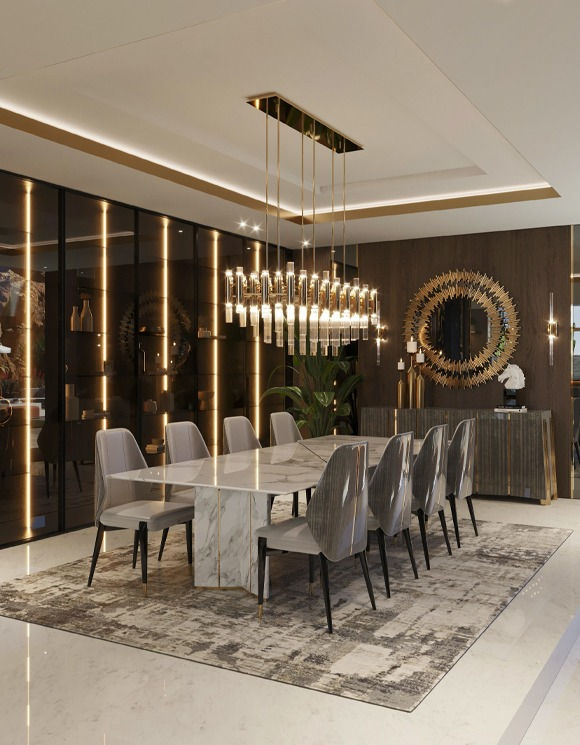
A clutter-free home is not an accident. It is a feat of engineering and design. It requires the discipline to subtract the unnecessary and the vision to invest in the essential. By embracing minimalist design principles—focusing on hyper-organisation, concealment, and material integrity—you create more than just a tidy house. You create a canvas for living. You build a home that lowers your cognitive load and restores your energy, proving that in the end, space is the greatest luxury of all.
To design the infrastructure for a calmer life, we invite you to explore bespoke possibilities with The Revealry’s design team.

Comments